(Double Header- When two great albums were released by the same artist within the year, but due to my top 10 criteria I couldn’t fit both without eliminating somebody else. Main album first and the not so strong album second)
10. Deep Purple Burn 1974 (EMI)
Hard Rock-Funk Rock
Hey......what the funks going on here!
Overview
After the terrible
Who Do We Think We Are album, which was then followed by the departure of both Ian Gillan and Roger Glover from the band. The famous Mk.II version of Deep Purple was truly dead in the water and this must’ve been a worrying time for Purple fans worldwide. Deep Purple knew that replacing Ian Gillan was going to be an extremely difficult task, so they went about replacing him through auditions and little known David Coverdale finally got the job. The band also hired Trapeze vocalist and bassist Glenn Hughes to replace Roger Glover and to also share vocal duties with David Coverdale. This new addition certainly gave the new Deep Purple Mk.III line-up some interesting options when it came to their music style. David Coverdale was a bluesy singer in the mould of Robert Plant and Glenn Hughes always had a funky tinge to his sound with Trapeze. But instead of giving us the self-indulgent Deep Purple Mk.II sound or the sheer power of
Machine Head, the band aligned themselves with a more basic hard rock sound with a strong commercial focus based around David Coverdale’s bluesy vocals and Glenn Hughes’ funky style. This allowed the band to usher themselves in with a boogie orientated sound, which incorporated a fair slice of both soul and funk and certainly the Glenn Hughes influence was most strong here. The second album on this ‘double header’
Stormbringer highlights these funky influences with even more clarity than
Burn. On both albums as expected, Ritchie Blackmore’s guitar operates as the main driving force, with riffs galore driving most of the songs along and Deep Purple yet again produced themselves on
Burn. The band retained the services of Martin Birch who operates as an engineer again, as he had done with the previous Deep Purple albums. He would’ve course keep his ties with Deep Purple throughout the rest of the decade and also go onto work with the future Rainbow and Whitesnake breakaways from the band.
Burn would therefore take the band in a very new direction.
David Coverdale- Vocals
Glenn Hughes- Bass/Vocals
Ritchie Blackmore- Guitar
Jon Lord- Keyboards
Ian Paice- Drums
Production- Deep Purple
Album
Burn- The show-stopping opener which quickly opens up with the bluesy tonsils of David Coverdale and accompanied by some blistering work from Richie Blackmore on guitar and Ian Paice on drums, and also gives us our first sampling of the David Coverdale and Glenn Hughes partnership, as both trade vocals on “Burn” as they do on most songs on the album. This song would be a concert staple for the Mk.III version of the band over the next couple of years.
Might Just Take Your Life- One of the more boogie sounding tracks on the album, that wouldn’t seem out of place on a ZZ Top album and again the lead vocals are traded between Coverdale and Hughes on this song.
Lay Down, Stay Down- One of the more up-tempo tracks on the album and a consistent listen from beginning to end, and again the song is propelled by the guitar of Ritchie Blackmore.
Sail Away- With its crunchy opening, this is a drifting sounding rocker and is probably the best all-round Coverdale and Hughes singing trade-off on the whole album.
You Fool No One- Another funky track to open up the b-side of the album and gives over to an intensive work out by the band.
What’s Going On Here- A straight-up boogie sounding number, which is laden with some of those traditional Ian Gillan vocal type hooks (despite not being with the band) and there is a great work out by Jon Lord on piano.
Mistreated- Along with the title track this the most famous track on the album. The song is a classic cut from its time and the song is seemingly perfect for David Coverdale’s bluesy wail, this is the song that finished off the original album. Some versions of the album have the instrumental
“A 200” as the final song on the album and to be fair it’s a basic instrumental in every way and certainly not worthy of a place on the album.
Verdict
The first thing noticeable about this album, is the revitalised feel of the band and this is very evident on the opening title track “Burn” with Ian Paice’s top-notch drumming throughout and Ritchie Blackmore’s solo in the later part of the song, which shows the band going for broke from the word go! Also we can’t forget Jon Lord’s contribution to the song, making it one of the very best in the whole Deep Purple catalogue. Then there is the funky sounding “Sail Away” which rubs shoulders with the title track, as one of the album’s real highlights. The trio of classic songs is then made up by the slow-burning “Mistreated” a song essential in every way and one of David Coverdale’s finest moments as a vocalist. The boogie aspects of the album, are mostly highlighted on numbers like "Might Just Take Your Life" which again has another great Ritchie Blackmore solo and it’s songs like these that really give the album its energy.
Burn has plenty of instrumental solos, but the band have decided not to ponder on the more self-indulgent solos of old and have presented their solos in a tighter manner all round. Without a doubt the band were seeking a commercial sound here and in that respect they achieved their goal, as
Burn sold by the bucketload. On nearly all the songs, there is the joint David Coverdale and Glenn Hughes vocal partnership, with David Coverdale being the senior partner here. But it’s Glenn Hughes’ influence that would be more dominant influence on the band though, in terms of the band’s direction. Just listen to his funky influence on “Sail Away” a song where his singing is given more airplay time than normal and this is the type of funky sound, that the band would go onto do more often over their next two albums. For years I never saw the finer points of
Burn, as I was always kind of aggrieved that Glenn Hughes had decided to leave Trapeze and take up second vocals behind David Coverdale, but on now reviewing this album, I see that the two actually complement each other very well and the vocals from both artists are superb throughout. The album now ranks in the top echelon of Deep Purple albums.
10. Deep Purple Stormbringer 1974 (EMI)
Hard Rock-Funk Rock
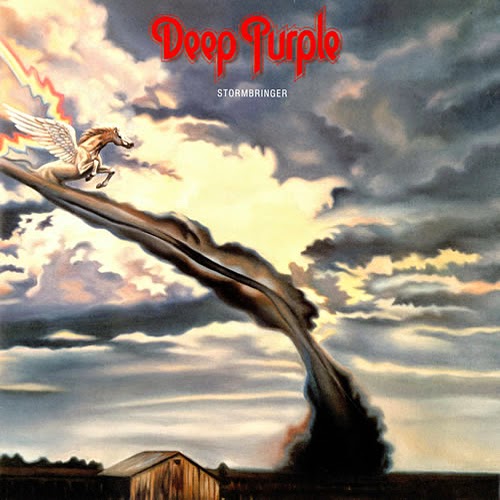 Funky and mystical, but the end of the road for Ritchie!
David Coverdale- Vocals
Glenn Hughes- Bass/Vocals
Ritchie Blackmore- Guitar
Jon Lord- Keyboards
Ian Paice- Drums
Production- Martin Birch
The Album
Stormbringer- Starts off with a synth intro before moving into rockier territory and in the typical driving start that we saw on "Burn" The song turns out to be a great exercise in muscular melodic rock and holds as one of the strongest offerings on the album.
Love Don’t Mean a Thing- A early chill-out offering blending soul and funk nicely together and with vocals shared between Coverdale and Hughes.
Holy Man- Glenn Hughes takes centre stage here and despite the odd pick-up this is something of a subdued effort mostly.
Hold On- Basically follows on from the previous "Holy Man" and in many ways could’ve been recorded by any number of rock and soul influenced acts of the time.
Lady Double Dealer- One of the fastest songs on the album and tries to pick up the energy at the start of the b-side of the album.
You Can’t Do it Right (With the One You Love)- Another one of the album’s outright funky efforts.
High Ball Shooter- A sweaty rocker highlighted by an infectious riff and one of the album’s faster tracks.
The Gypsy- A ponderous track with a melancholic feel and one of the more accomplished tracks on the album.
Soldier of Fortune- The slow and ponderous album closer which is normally held in esteem, as one of the most important songs on the album.
Verdict
Of the three albums that the Mk.III line-up recorded
Stormbringer is the lesser of those three albums and sits in between both
Burn and
Come Taste the Band in their discography.
Stormbringer though, is the album that sounds most akin to the future Rainbow, which is no surprise as this would be the last album that Ritchie Blackmore did with Deep Purple until the mid 1980s, as after
Stormbringer he upped and left with his guitar and formed Rainbow. Just listening to the title track “Stormbringer” David Coverdale’s vocals could easily be replaced by Dio here and wouldn’t have seemed out of place on the first couple of Rainbow albums! In fact the same could be said for the similar paced “The Gypsy” one of the album’s later songs.
Stormbringer would be the funkiest album that Deep Purple ever put out and its blend of rock, soul and funk are evident across a number of songs, songs like “Love Don’t Mean a Thing” and “You Can’t Do it Right” are among the most funky. There are also a couple of faster tracks on the album, such as “High Ball Shooter” along with some very slow tracks like “Soldier of Fortune” which do add a bit of variety. The funk that was hinted at and briefly developed on
Burn, now takes more of a central stage on
Stormbringer and without doubt
Stormbringer is an attempt for the band to break some new ground. The huge commercial success of
Burn and the California Jam festival of 1974, had given the band the perfect stage to try and expand the funk elements featured on
Burn. The problem is though, that
Stormbringer fails to ignite in a way that
Burn did, the songs are there but the execution seems too subdued at times and a greater song development could’ve brought the album up to the level of
Burn. Despite this negative opinion about the album,
Stormbringer is still an interesting listen but really just an album for Deep Purple fans. Because anybody expecting a high-octane listen as the album title would suggest, is going to be in for a big disappointment.