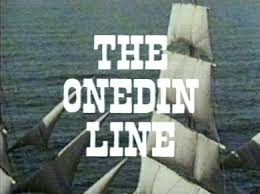
 Season One, Episode Nine
"When my ship comes home"
Season One, Episode Nine
"When my ship comes home"
Another disaster for James! Large profit can come with large risk, but that can turn around and bite you, and in this case it has. He had paid to charter one of Callon's ships by mortgaging the current cargo of his own, the
Charlotte Rhodes. He had thought to make a handsome profit, but the ship was lost at sea, and now Callon owns the cargo James was going to ship. Robert is not happy, not only that they have been left high and dry, but that his brother took this decision and went to Callon without consulting his other partner in the venture. Robert is feeling more and more like a silent partner in the Onedin Line as time goes on.
And things are not getting any better for the beleaguered older Onedin brother, as Callon wants the chandler's shop, which stands in the way of a new dock he wishes to build, but Robert has (rudely, according to Elizabeth) turned him down. James is on his way to London, to the Stock Exchange, there to enquire after the lost cargo. Anne decides she cannot pass up the opportunity to go to the capital, and despite his grumbling protests she accompanies him. There he meets Chubb, the insurance agent and the captain of the ship, and is given bad news. Under instructions to pick up return cargo for the voyage back, the captain assembled a mixed cargo, among which was some gunpowder. This was responsible for the accident and Onedin is not insured, as he did not take out a specific dangerous goods policy. Insurance agents, huh?

And that's not the worst of it. As if this day could not get any worse, Onedin is advised by the obsequious agent that they are holding him liable for both the ship and the cargo. Not only will he not receive a penny in compensation, but he will get a bill for thousands, perhaps more. It looks like he will be made bankrupt. But a chance visit from the erstwhile captain of the lost vessel imbues him with new hope when he hears that, contrary to what Chubb told him, he is not responsible to his partners in the insurance firm. Not really, as he is the senior partner and so the main decision taker. James hatches a plan to get him drunk, and invites him to dinner.
As it happens, his plan takes on a life of its own when Chubb takes them to his favourite cathouse, where they meet the wholly unlovely but immensely rich Kate who owns the place. She does not get on with the earthy seacaptain and when she gets a chance to shop him to Chubb she does, showing him the letter James is carrying with him, after he has become a bit the worse for drink. His plan, like his finances, in ruins, James is delivered home to Anne by Chubb. When the insurer makes light of the fact that he did not sign Onedin's letter, thus releasing him from his debt, Anne bridles and give Chubb a piece of her mind.
Callon goes triumphantly to see Robert and demands he sell him the shop. If not, he'll drop the price every day until he does sign. His son, however, lets slip the recent act of parliament which limits the liability of any director on the board of a Company to the amount of its share capital. This means --- and Robert is listening intently, if not in much hope --- that Callon cannot bankrupt Onedin by asking for his debt to be paid because James has arranged it that his largest, and therefore first in line, creditor will be himself: Onedin Warehousing Limited. They cannot take an action against James, or Robert, personally, only the Onedin Line, which was the entity that chartered Callon's ship. Unfortunately for him, Callon has pressured his son into telling him all of this in front of Robert, for whom the penny finally drops: Callon has no hold over him, his shop or indeed the Onedin Line.
However, Callon can stop the Onedins from earning a living, by having the
Charlotte Rhodes impounded (he can do nothing about the
Pampero; that's off in Portugal) and taking all the business he can from the Onedins while they're unable to fight back. Sarah blames her husband for being weak --- as she always does. She was happy, proud as punch and like a peacock when Robert became a company director, but as James hardly even consults his own brother when making the most important of decisions, she sees his seat on the board as largely empty, lipservice to the family, a way for James to finance his voyages without putting himself in debt. When she learns to her horror that their home is to be repossessed by the bank, and they are to be thrown out onto the street, she is almost hysterical. The end up having to take a room at James and Anne's house; after all, it's their fault they are homeless.
Meanwhile, James has returned to Liverpool, and is not about to let a small setback like his ship being seized stop him. With the help of Baines, he steals the
Charlotte Rhodes and heads off under cover of night, on one last trip which he hopes will sort all his woes. As usual, it's risky: he goes to Gibraltar and runs guns to the rebels. When Anne discovers that he is transporting weapons to people whose stated aim is to overthrow the Crown, she is aghast, but to James politics should never get in the way of business. He's as patriotic as the next man, but as we shall see as the series goes on, he's quite the mercenary, fighting for --- or in this case, shipping for --- the man who will pay more, no matter his allegiances.
With the fabulous profit he makes from his illegal venture, James is now free to return home and pay off his debts, his ship again his. But has he overstepped the mark with his wife? In agreeing to trade in arms --- and further, in arms going to rebels who oppose the Queen's authority --- has he gone too far? Anne does not look happy.
QUOTES
Robert: “I've told you time and again, James, these risks will bring you to a bad end!”
James: “Us, Robert.”
Robert: “Aye. Us.”
(James has no compunction in reminding Robert, as he has before, that if he wishes to share in the profits he must also be prepared to share in the losses)
Elizabeth (on hearing about debts her brother owes): “These debts ...?”
Anne: “We'll pay our own debts!”
(They may be strapped for cash and barely surviving, but Anne is proud and determined enough to cut her sister-in-law off before she can make an offer of a loan, or help. She does not want charity, and she does not want Albert Frazer bailing them out. Canny as she is, she knows such kindness on the surface would translate into an even heavier debt that might drag them all down in the end.)
Elizabeth (on hearing Anne plans to go with James to London): “And what about me?”
James: “What about ye?”
Elizabeth: “So near to my time, and everyone away...”
James: “That's enough of that.”
(It's obvious James has little or no sympathy for his sister; she got herself into this mess and there's no point crying about it now. He has no time for her protests, though he does try to use it as an excuse to stop Anne from coming with him, saying his sister may need her. Anne replies with a sharp “Elizabeth will give birth with our without us. She needed no help to conceive!” Ouch!)
James: “Anne, we're ruined.”
(The first time we've ever heard defeat, real despair in the voice of the man who would be king...)
Anne (watching James fold a piece of paper he has written on and put it into his jacket pocket): “Now what is that?”
James: “A piece of paper.”
Anne: “I can see that for myself.”
James: “Better you not know.”
Anne: “Oh.”
(Anne knows well that her husband is a slippery customer, and probably suspects he is up to something, but if it will get them out of the situation they have found themselves in, she will not try to dissuade him and will leave him to it. As she once herself observed, she has no desire for penury, and at the moment that's the direction the Onedin family is heading).
Robert: “You cannot bankrupt us!”
Callon: “I can, and will. And be pleased to do it.”
(Of course he will. Ever since James left his employ to set up the Onedin line the man, the entire family has been a thorn in Callon's side. If he can behead the snake now --- cut off James's supply lines and storage facilities and his shipping line will wither like a dying flower --- he will, as he says, be most happy to do so and remove forever this prickly annoyance from his flesh.)
Elizabeth: “James uses people, even family. He pushes them into his plans and schemes; he has no thought for anyone else.”
(Pot, meet kettle!)
James: “They'll forgive a rich man anything!”
(How true. When James stole the Charlotte Rhodes he had but a few hundred pounds to his name, and mounting debts. On his return he has ten times as much; enough to pay off Callon and any fines for stealing his ship, and surely the incident will be forgotten and forgiven once a little gold coin changes hands?)
MANNERS AND MORES
Poor Robert! He simply cannot accept the possibility that his sister, an Onedin, might be carrying a child which was conceived outside of wedlock. Even though he, Sarah and of course Elizabeth herself know that the child is Daniel Fogarty's (as does James of course) he has convinced himself that it is in fact fathered by Albert Frazer. With all he's going though at the moment, he has to hang on for grim life to one unalterable fact, that his sister is not a harlot. Elizabeth of course delights in confirming that the child is Daniel's, if only to make his blood boil. But in reality she is as disgusted at his wilful blindness and refusal to accept the truth as he is with her for being a loose woman.
Despite the fact that we're talking about Victorian London here, where a woman dare scarcely walk the streets unaccompanied --- James warns Anne against such “scandalous” behaviour before he goes to meet with Chubb --- there seems to be no problem with people running brothels. And as with all such establishments, they're the playground of the wealthy, the intelligentsia and the well-connected. James looks archly around when he arrives and no doubt notes lawyers, judges and politicians as well as tycoons and military officers in attendance. It seems that brothels are only frowned on if they're cheap and tawdry; the more expensive and lavish the cathouse, and the more of the “right type of people” who patronise them, the more acceptable they are to rigid nineteenth-century English society.
ONEDIN'S RIGHT HAND
Always a man to depend on, Mister Baines is not always treated as he should be by his employer. In fact, James almost always takes him for granted, and would be the last one to call the man a friend. But he is, and he risks much, time and time again, helping James out when he could so much more easily jump ship and go to work for Callon, or indeed any of the other shipowners. But Baines is a man who prizes loyalty highly, and though he no doubt rankles at the treatment he receives almost constantly from Onedin, he will always be by his side. In this section I'll be pointing out the times --- and they are many --- when Mr. Baines makes himself indispensable, when he almost singlehandedly saves James's neck, and when, without his assistance, friendship and steadfastness, the owner of the Onedin line would be sunk, financially and sometimes literally.
Here, with little to gain really, and the possibility at the least of losing his Mate's status and never being allowed to serve on a ship again, and at worst of being thrown in jail, along with his employer, Baines helps Onedin brazenly steal the
Charlotte Rhodes, which has been seized and impounded. I'm not sure what the sentence is for stealing your own ship, but in nineteeth century England I can imagine it was more than stiff. They took the letter of the law very seriously back then. But Baines doesn't even bat an eyelid; he has done, and will do, worse in the service of this extraordinarily ungrateful user of people. And yet, he would likely have it no other way. James for his part doesn't even question Baines's complicity in his plan: he's simply expected to follow orders like any good seaman. But this is above and beyond the call of duty, not that James would recognise or even admit such a thing, never mind reward it.
Of course, you could say that with Baines it may be a case of enlightened self-interest, as G'Kar puts it in Babylon 5: if Onedin goes out of business there may be no more work for him. Certainly, someone would take him on --- he's an experienced mate, after all --- but whether or not he'd hold his position of command or not is debatable, also whether he would be paid the same. Even so, the fact that he's willing to risk jail for his employer speaks volumes about the man.
HISTORY LESSONS
The Limited Liability Act of 1855 was a Act of Parliament that took away from companies the burden of being responsible for a full debt, and excluded the shareholders of any Limited Liability Company (LLC) from being called upon to cover any debt incurred by the company, personally. Only the company itself could be sued, if legal action were required, and only the assets of the company could be seized. Robert Onedin is unlucky here, as his house and the chandler's shop he runs are part of the collateral put up for the purchase of shares in The Onedin Line, and thus seen as assets of the company, and thus seizable, as is the ship itself. James's house --- presumably in his wife's name and not his --- is safe from repossession.
Robert is able to benefit from this new law --- though he would not have heard about it had it not been for Edward blabbering in front of him at the insistence of his father --- when he realises that Callon cannot bankrupt him personally, only the company, and only after the main debtor, their own Onedin Warehousing, has been paid. Nevertheless, that does not mean that Callon cannot make life very uncomfortable for the Onedins, as we see later.
It's a point to note though, that the younger Callon, aware that he might be giving Robert ammunition he would not otherwise have in his fight against them, wishes to say as little as possible in front of the shopowner, and on several occasions tries to communicate this to his father, who is having none of it. “You're so fond of contradicting your father”, he says in annoyance, “Say what you have to say in front of Mr. Onedin. No doubt he may find it most ... edifying.” Too late, he realises how right he is, and what a mistake he has made. Perhaps next time he will listen to his son?
As they prepare to land their smuggled guns, the
Charlotte Rhodes is approached by a French vessel. The captain threatens to fire on the ship, but James shouts back that if they do then the English Navy will blow them out of the water. He's bluffing here of course; they are engaged in illegal activity and not only that, they are running weapons to enemies of the British Empire, so any English ship is more likely to fire on them than the French. But the French captain does not know this: it's dark and he can't see Onedin's ship. He may think it itself is a British war frigate, and will rightly fear reprisals should he fire. At this point, the French are not at war with England (for once), but the reputation of the British Navy is so fierce that even a threat of them being involved is enough to stay the Frenchman's hand. Also, he hardly wants to be the one to bring about another war, especially should it turn out that his has all been a misunderstanding.
And isn't that...?
The arab for whom James ships the weapons (who is never named) is none other than Nickolas Grace, whom we have seen recently as the luckless Sheriff of Nottingham in Robin of Sherwood, and whom we will encounter again in the third and final part of the House of Cards trilogy.