We know Christian metal exists. We know that Black Metal exists. But is it possible that Christian Black Metal could be a thing? Surely not. Actually, yes. Yes it is. The idea of one of the most overtly anti-Christian subgenres in metal being used to sing the praises of the very god it purports to hate (if it even believes in Him) is so unlikely as to send you out buying a lottery ticket with a good feeling. But yes, it does exist. Back in 1990, there were bands and musicians who, although they loved the heavy, chaotic and dark themes of black metal, were either Christians or just disliked the idea of attacking God and Christianity, and so they formed a new subgenre.
Originally labelled “white metal” by Metal Blade Records owner Brian Slagen when Trouble released their Bible-inspired
Psalm 9 album, a label Trouble's vocalist Eric Wagner described as “a bunch of crap”, the term unblack metal was taken by bands like Horde and Antestor, who sprang up in 1990, with the only member of the former, Jayson Sherlock, recording Horde's first album
The Holy Black under the name Anonymous, possibly as a f
uck-you to Mayhem founder and guitarist, the late Euronymus, who was mentioned in the original Metal Month, you may remember, when I wrote an editorial called “It's only rock and roll ... isn't it?”
Slowly, and very few in number, other bands began to adopt this image, but there was no great sudden breakout or movement of unblack metal until the twenty-first century, when black metal itself was beginning to struggle slightly and had lost its stranglehold over the Scandivaian metal scene. Much of this reluctance to form any sort of movement was due to the overt hostility, both from black metal bands and their fans, towards bands they felt were, consciously or unconsciously, mocking their traditions and, in the best tradition of fascism and racist rhetoric, polluting their purity. Euronymous even threatened Antestor, when they were known as Crush Evil, trying to force them to disband, but the eternal Ouroboros of black metal intervened as a dispute between him and Varg Vikernes resulted in the Mayhem guitarist's murder. Fans sent death threats to the offices of Nuclear Blast Records, who were signing the few unblack metal bands who popped up, so life was not easy for them, nor I assume for their fans, and I can imagine they played few if any live shows.
They remain few in number, and many have already either broken up or moved in other directions. But in 2000 there was an increase as other countries began to get in on the act, such as South America, the USA and Central Europe. The usage of the term “unblack metal” has caused some problems too, where some of the bands prefer not to associate their music with black metal at all, and describe their sound as everything from “unblack holy metal” to “sorrow metal” and of course the obvious and again somewhat contradictory “Christian black metal”.
At some point next year, I may explore this in more detail but for now I want to focus on just the one band and the one album. Like many Norwegian black metal bands, they a) released only two albums b) released what is accepted to be something of a classic in the subgenre for their debut c) changed direction for their second album and d) are now split up. They sing (!) in their native Norwegian, so on the surface there might not seem to be that big a difference, as with most black metal bands I can never understand the singer unless I have a lyric sheet handy and he's singing in English --- they could be praising Satan and arranging for twenty-four virgins to be sacrificed, or screaming their shopping list while complaining how hard it is to set the programme reminder for
Gray's Anatomy for all I know! --- but luckily I not only have a lyric sheet but a translation, so it will be interesting to hear just exactly what unblack metal bands sing about. I mean, Horde do apparently have a song called “Release and clothe the sacrificial virgin”. I'm not kidding.
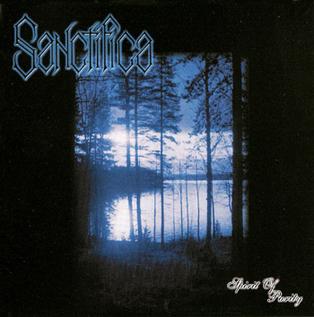 Spirit of Purity --- Sanctifica --- 2000 (Little Rose Productions)
So what are we to make of an unblack metal album? Well, firstly I can see the songs are all pretty short relatively: nothing over five minutes. In my admittedly limited experience of black metal, the songs tend to be longer, though in fairness this is truer of atmospheric black metal, as we're seeing in the “What's that all about?” section. Sanctifica were not a one-man show, and while this is by no means a requirement or even representative of black metal, I have found that many of the artistes in this subgenre tend to prefer to work alone, or maybe with one other person. This band had a lineup of five full members. They also used keyboards, which again, some black metal bands did and do, but generally they seem to tend to go more for the basic, I guess more brutal setup of guitar (one or more), bass and drums.
But it will of course be in the lyrics that we will see the difference. I'm assuming that if Satan is named at all, it will be with either hate or a sense of trying to turn the listener from His dread influence, and I'm also expecting that, contrary to the often doom-laden, hopeless and angry approach in black metal lyrics, this should focus more on joy, life as something to be lived, the everlasting glory of God, and so on. Basically, it should be, lyrically if not musically, everything that black metal both is not, and also strives against. The very anathema, again only lyrically, of the darkest subgenre of heavy metal.
It's almost a hymn as we begin, with church organ keyboard but then it suddenly explodes into that familiar, blindingly-fast, powerful and chaotic sound we associate so much with black metal, and yes, if I didn't have translations of the lyrics I would be totally ignorant as to what was being sung, as Hubertus Liljegren sings exactly as you would expect any black metal vocalist to sing: screechy, sibilant hissing that would make it next to impossible to make out any words were he actually singing in English. But the lyric to “Riket (The Empire)” betray his Christian ideals, as he appeals to God and not Satan:
”Break O Lord, surpass and rout the power/ And dominion of darkness.” The music though, is a lot worse (as it were) than a lot of the black metal I've heard, and were it not for the purposes of research for this article this is not something I would listen to.
Oh, I'm wrong: he
is singing in English. Apparently. The first song just had some Swedish lines in it. Now we can hear (with the aid of the lyric sheet) the true difference as he declares
”Like the dew of the morning delivers the cold shape of night/ As rays of hope brings a dawn of freedom/ Emperor of universe release my bonds /And set me free by the blood of Christ.” Euronymus must be spinning in his grave! He'd probably approve of the music though: hard, fast, a real assault of guitar drums and bass, and the vocals just the kind of thing the Mayhem guitarist probably liked to unwind to after a hard day's burning down churches and eating babies. In “Released from pain”, Liljegren encounters
”A lamb, nailed to a cross” but whereas any self-respecting black metal musician would laugh and carry on, or maybe tear its head off, our man falls to his knees and begs for peace and forgiveness. It's hard to get your head around, I can tell you. Sort of like that rabbit in Monty Python, though reversed I guess. Like being mugged by a kitten.
Jesus again comes to Liljegren's rescue in the title track, which is one of the longer ones, at six and a half minutes, as he exults
”The demons of darkness cannot fight him/ His power is eternal.” It's interesting, but the problem I have is that as black metal goes, it's down there with the worst of them musically. I mean, I'm no fan of the subgenre but I've been listening to some of it over the last few months, and some has impressed me. Some has not. This does not. It's too samey, too chaotic and too unfocussed. The lyrics are the only interesting things about the songs that I can see, and even then, once you get over the initial novelty of hearing him praying to and praising God rather than trying to destroy or deny Him, it's fairly much the same thing all through the album: save me Jesus, you are the King, I love you, you will save me, and so on. There's a reason why Christian metal is often very boring, and this is it. If you're going to do nothing more than essentially praise god in every song, your audience is going to run out of patience pretty quickly. And it's happening here.
What I liked about a band like Theocracy or Narnia is that they used Christianity but did not rely solely on it for their lyrics, and they know how to expand and branch out from simple worship of God in every song. Liljegren, it would appear, never learned that lesson. At least, I'm halfway through the album and he hasn't so I can probably safely assume he didn't suddenly “see the light” (pun intended – whaddya mean, what pun?) over the next four tracks. In fairness, the music is getting a little more cohesive, even symphonic here near the end of the title track, so maybe there's hope for this album yet. “Allhärskare” (The Emperor) directly contravenes the likes of Quorthon by welcoming Jesus into the Scandinavian lands and swearing fealty to Him:
”Your spirit is sweeping over the nordic realm./Your light will shine forever/ Master over the whole universe/ You are our emperor, our father.” The music is decent too, kind of slower and marching with some stuttering guitar and hammering drums. He sings this one in Swedish too.
“Landscape” opens with a really nice piano intro, but soon blasts out into a fullblown black metal assault with some gothic/symphonic and even power overtones. Funnily enough, if you didn't know this was unblack metal the lyrics could be taken as proper black metal ones, as the sentiments --- giving your life to a power greater than you, talking about its mastery over you and the world --- kind of reflect what black metal lyrics drive at, and Liljegen could as easily be singing about Satan as Christ here. On the other hand, “The dark embrace of night”, while on the surface a black metal song title, is all about God protecting His creatures from the dark and sending the sun back in the morning to illuminate their lives. You wouldn't know it of course from the melody, such as it is. The album then ends on the longest track, seven minutes of “The wanderer”.
Replete with woe, decisions to be made and confusion in the heart, the song again could be a poem to Satan but for the final lines, which I'll get to in a moment. But right now I'm intrigued by lines that seem to throw into sharp relief Liljergen's pain at trying to walk a line between Christianity and black metal, when he moans
”I met many who claimed the smaller path to be the better /Yet most men seem to choose the other.” Perhaps even here he may be thinking of changing tack, not to pure black metal of course, but in a more progressive metal direction, as was apparently evidenced on their next, and last, album. The intro to this is certainly far more prog metal, with its sweeping keyboard soundscape that takes up the first ninety seconds of the song, though then the band pound on into their normal unblack metal territory. Even so, the song has changes and shifts that do mirror closely those in prog metal. He even changes to “clean” vocals right at the end. It's almost as if he's unsure what he wants to do, though he makes it clear in the final lines that his allegiance has not changed, when he speaks the last words of The Lord's Prayer, ending on the ultimate affirmation of Christianity,
”Amen”.
TRACKLISTING AND RATINGS
1. Riket (The Empire)
2. The dark desires
3. Released from pain
4. Spirit of purity
5. Allhärskaren
6. Landscape
7. The dark embrace of night
8. The wanderer
I'm in two minds. After hearing this album I'm not sure I'm still that eager to explore this weird sub(sub?)genre further, and yet it is only one album, and who's to say what other surprises lie in the shadowy-but-not-shadowy world of unblack metal? Perhaps I'll check it out further in 2016. For now, it's been an interesting, if not quite an eye-opening experience, and as Kyle says: