RICHARD M. NIXON (Here's to the State of Richard Nixon)
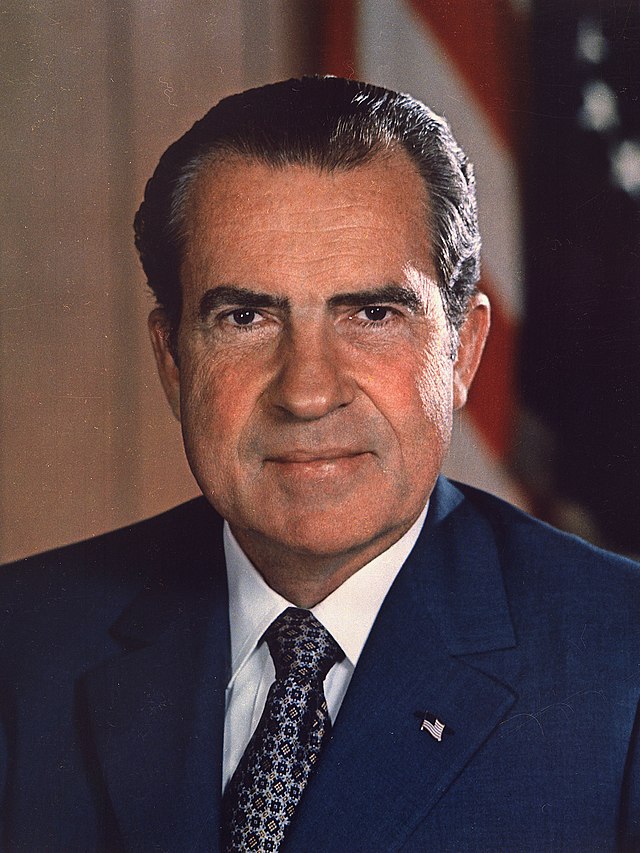 Born
: January 9, 1913, Yorba Linda, California
Died: April 22, 1994, New York, New York
Term: January 20, 1969- August 9, 1974 (resigned)
Political Party: Republican
Vice President(s): Spiro Agnew, Gerald Ford
First Lady: Patricia Ryan Nixon
Before the Presidency: Richard Nixon grew up in a small town in California. He was the son of an odd mix of parents. His father was a bit of a boor while his mother was, as he would famously put it, a saint. Young Richard was ambitious from the start and excelled at school and would excel at Whittier College and Duke University law school. Even with his impressive academics, however, he couldn’t get into the FBI when he applied in 1937.
Nixon settled in Whittier, California where he met and married Pat Ryan, destined to be his long suffering wife. The Nixons moved East as opportunities began to present themselves. Nixon got a job with the Office of Price Administration in Washington.
After Pearl Harbor, Nixon enlisted in the Navy. It wasn’t an especially distinguished stint, but he left with an Honorable Discharge in 1945. When he got home, his political career started when he was approached by a group of Southern California Republicans.
Nixon learned the art of negative campaigning and dirty tricks from the get-go, and he set his eyes on Jerry Voorhis, the Congressman from California’s 12th District. Voorhis was a New Dealer who was also an avowed anti-Communist. No matter, Nixon’s men was able to come up with a document linking him to a PAC, not a Communist backed PAC mind you, but enough to scare the votes enough to go with Nixon. Richard Nixon was going to Washington.
This was the period of the Great Red Scare and Nixon would exploit it as hard as he could. Next in his crosshairs was Alger Hiss, a prominent employee at the US State Department. He was under investigation by the House Un-American Activities Committee in which Nixon was a member. Nixon went after Hiss like a pit bull, all but destroying his career (though later documents suggest that Hiss was, in fact, passing information to the Soviets). Nixon had reached National prominence.
Buoyed by the success in the Hiss case, Nixon then went for the Senate seat. This time the victim was Helen Gahagan Douglas. He came up with a “pink sheet” that compared Douglas to a Communist Party member, calling it the Douglas-Marcantonio Axis. This not only won Nixon the Senate seat in 1950 but also the derisive moniker, Tricky Dick. Yes, Richard Nixon was a despicable man even in the early days, but in the paranoia days of the early fifties, he was the next best thing next to Joe McCarthy.
And as such, he was being touted as a possible Vice Presidential candidate in 1952. Eisenhower would go with Nixon after Nixon guaranteed some California delegates. Eisenhower may have regretted it though as it wasn’t much long before Nixon became the news in not a good way. A news article accused Nixon of taking illegal gifts and Eisenhower was ready to dump him. Nixon knew this too.
So, with TV now the rage, he arranged what we would now call an informercial that we know now as the Checkers speech. Here, Nixon highlighted his dog, explaining that Checkers was a gift given to him for his daughter and he wasn’t going to give the dog back. It was pure manipulation at its best as Nixon came off as a warm family man. Nixon saved his place on the ticket.
And, despicable as Nixon was, he did have a soft spot for his family. His wife was devoted to a fault and his two daughters adored him. This would come into play later when his political career came to a spectacular end.
Eisenhower won the election easily and Nixon was the youngest Vice President in history. As Vice President, Nixon would become an expert in foreign affairs, visiting dozens of countries. There were two notable trips in particular. On the Latin America Trip in 1958, Nixon was met with protests and a mob in Caracas stoned his motorcade. This only made Nixon more popular.
The incident that gave him real glory happened in 1959 though when he met Nikita Khrushchev in the Soviet Union. There the two staged what was called the Kitchen Debates as they traded words about the merits of their two respective countries. Both parties looked quite positively, and it gave Nixon a reputation of being able to stand up the big boys.
Nixon even had some Presidential experience when he had to fill in as Acting President when Eisenhower suffered his heart attack in 1955. Nothing major happened and, for all extensive purposes, Nixon didn’t do anything to embarrass Eisenhower when he returned.
So, when 1960 rolled around, Nixon was a prime candidate for President, and he would be nominated by the Republicans. Nixon wouldn’t be ready for the glamour that was Kennedy though and this time, the same TV that saved his political career would now be his Achilles hell. The two candidates, who were also personal friends, decided on four televised debates. Kennedy was a handsome man and was able to show his charm in front of the cameras. Nixon, on the other hand, looked like he hadn’t shaved, and while he may have had a better grasp of the issues than Kennedy, his delivery seemed off and people were turned off by his general appearance. As such Kennedy won the debate.
And, despite some controversy, Kennedy also won a close election. It’s true Nixon could have contested it, and no one could have really blamed him, especially in the case of Illinois, but Nixon decided not to contest the election and conceded gracefully. Nixon figured he’d just try again in 1964.
But first, he would try a stab at California Governor in 1962 after writing his book, Six Crises. Nixon ran as a moderate against the staunch conservative, Joseph Shell, in the primary, and won the nomination easily. The general election was a different matter though as the Democratic Governor, Pat Brown, was quite popular. Nixon felt the press liked Brown a little too much too and, when Nixon lost big in the general election, he announced that they wouldn’t have Nixon to kick around anymore.
Nixon instead spent the bulk of the sixties campaigning first, for Goldwater, then for Republicans in the 1966 midterms. For somewhat who had been supposedly retired from politics, he seemed to be ready for another Presidential run in 1968
Summary of offices held:
1942-1946: United States Navy, Commander
1947-1950: House of representatives, California
1950-1952: United States Senator, California
1953-1961: Vice President of the United States
What was going on: Vietnam War, The Apollo Space program, Kent State, relations with China, Energy Crisis, Watergate
Scandals within the Presidency: Agnew tax fraud trial, and, um, Watergate
Why he was a good President: He was surprisingly strong on the environment, creating the EPA among other things. It took him long enough, but he did finally get us out of Vietnam. And the space program flourished under him. Plus, he handled the inflation issue about as well as anyone could have in the early seventies. And, of course, he was very adept at foreign diplomacy, forging relations with China and signing the SALT nuclear arms agreement with Russia.
Why he was a bad President: Well, Watergate of course, but his paranoia sometimes would go amok as he wasn’t afraid to curtail the civil liberties of those who protested his policies, particularly when it came to Vietnam. Plus, who remembers his infamous enemies list?
What could have saved his Presidency: A lot less paranoia and more of where he did best, with foreign diplomacy and moderate domestic policy. Oh, and a little more honesty and openness wouldn’t have hurt either
What could have destroyed his Presidency: Oh, I don’t know, maybe a political scandal? You know, like, WATERGATE????
Election of 1968: Nixon came into 1968 as the Republican front runner with George Romney and Nelson Rockefeller on the left and Ronald Reagan on the right. Reagan, at this point was a former actor who was now Governor of California (he did what Nixon couldn’t do, defeat Pat Brown). Reagan had taken the mantle of Goldwater conservatism and it was he who would transform the United States into the wonderful wasteland it is today. For now, though, he was just beating up hippies in California.
Despite the loyal competition, Nixon’s nomination never really was threatened. Romney dropped out after he turned against the Vietnam War and Rockefeller was way too liberal for these Republicans. On the other hand, Reagan’s conservatism scared the pants out of them. They much preferred someone close to the center, in other words, Nixon.
So, Nixon was up against Humphrey in the general election (see the 1968 chapter for the fun on the Democratic side). A third candidate also had his hat in the ring. Mr. Segregation Now himself, George Wallace, was running on the third party American Independent ticket, and he would indeed make some noise, though he probably would hurt Nixon more than Humphrey.
As for Nixon, he ran on a law and order campaign, essentially a reaction to both the civil unrest of recent years and the student protests that were getting out of control, such as in Chicago. He also had a secret plan to get out of Vietnam (he didn’t but people are pretty gullible sometimes). And, oh yeah, he also had as his running mate, Governor Spiro Agnew of Maryland. Great, so Nixon would not only embarrass himself a few years later, his Vice President would embarrass my home state as well (In 1973 for sure but one can argue he started to embarrass us in 1969).
Anyway, even though Humphrey was gaining on Nixon in the days before Election Day, it was too little too late. Nixon won with a razor thin plurality (yep, yet another plurality), though he fared a little better in the Electoral Vote with Wallace gaining most of the Deep South. Nixon took the rest of the South which fulfilled LBJ’s prediction from four years earlier. Hatred doesn’t die very easily.
First term: Buoyed by the support of his “Silent Majority,” President Nixon embarked on the first of his international trips, the first one being to Europe. Back at home, Nixon would concentrate on two things in his first year, scaling back the war in Vietnam, though not ending the involvement, just that fewer men would have to go. He also had to deal with the political unrest at home as young protesters were now being attacked by groups that called themselves Hard Hats. When you say Hard Hats, think of a lot of violent Archie Bunkers on steroids. Nixon, not a fan of the protestors, was certainly favoring the Hard Hats, at least in secret.
When it came to foreign policy, Nixon was a hands-on President, keeping his Secretary of State and Secretary of Defense out of the loop. He had a group of trusted aides around him from Chief of Staff HD Haldeman to security advisor Henry Kissinger. As such, he was often commanding the Vietnam War from the White House.
Domestically, things started out well, but inflation was becoming a major problem. By 1971, and despite Nixon’s best efforts, it had spiraled out of control to the point that Nixon ordered Wage and Prize freezes over the next year in hopes to get the inflation under control. It didn’t really work though as domestic policy really wasn’t Nixon’s forte, but he would sign off on the Environmental Protection Agency and signed the Clean Air act.
Nixon was President when NASA had its greatest moment. John Kennedy’s dream of a man on the moon before 1970 had been realized as Neil Armstrong took the first steps off Apollo 11 in July 1969. More moon missions would follow throughout Nixon’s first term.
But like Johnson before him, Vietnam was ultimately Nixon’s Achilles Heel. Even though Nixon was now slowly withdrawing troops from Vietnam, there was still a draft, which was now a televised lottery (Congratulations to those born on September 14th, you win a free trip to Vietnam), and the withdrawal was much too slow for not only the young, but for middle America as well as many of them had now turned against the war (The 1968 Tet Offensive being the turning point for many). On top of that, Nixon replaced troop withdrawals with bombing missions in North Vietnam. By 1970, it had spread to Cambodia and Nixon announced that US planes had bombed that country as well.
College campuses all over the country erupted in protest over the Cambodia bombing and it reached a boiling point when National Guardsmen fired on protestors at Kent State University in May 1970. Four people were killed, two of whom were only observing the protests in between classes.
Nixon, to his credit, didn’t overreact as now colleges were shutting down in the wake of the Kent State tragedy (another shooting incident also happened at black college Jackson State later that month). Instead, he tried to talk directly with a group of anti-war protestors at the Lincoln memorial. Yes, it was as bizarre as it sounds, and Nixon was no doubt feeling out of place as he tried to get with it.
Nixon ultimately was quite the paranoid, especially when it came to Vietnam. He had the Oval Office secretly bugged as a way to use it against those that may oppose him. Needless to say, that backfired spectacularly. He also would go back into his bag of dirty tricks as the Pentagon Papers were being published in 1971. His Attorney General, John Mitchell, was something of a pit bull and he would be used to discredit people and, in the case of Daniel Ellsberg, even try to prosecute. Mitchell also would take initiatives on his own as when he tried to deport John Lennon in 1972.
Even with all the fun and games going on around him, Nixon still had a bit of political capital going into 1972, and his trip to China would prove to be the most lasting achievement of his administration. He struck a diplomatic relationship with Chou En Lai and Americans were seeing Red China in a positive light for the first time. Critics called it Ping Pong diplomacy, but it worked. Nixon would also have talks with Brezhnev later and he would be credited with toning down the rhetoric of the Cold War quite a bit.
1972 was, of course, election season, but it was also the year of the Paris Peace Accords. Henry Kissinger even went as far to say that pace was at hand, though that proved to be premature. North Vietnam, having the upper hand really, was still playing hardball, so Nixon ordered more bombings of North Vietnam as 1972 ended, after all Nixon was already re-elected, what could they do to him now? In the end, North Vietnam signed the accords, and the US was finally getting out of the war as Nixon’s second term began.