Welcome to Music Banter Forum! Make sure to register - it's free and very quick! You have to register before you can post and participate in our discussions with over 70,000 other registered members. After you create your free account, you will be able to customize many options, you will have the full access to over 1,100,000 posts.
Location: Beating GNR at DDR and keying Axl's new car
Posts: 48,199
Quote:
Originally Posted by Kiiii
My response was more relating toward the fact that TH is really getting monotonous with his journal ideas. This could easily fit into his Couch Potato journal.
You review video games, you retard, and not particularly well.
__________________
Quote:
Originally Posted by J.R.R. Tolkien
There is only one bright spot and that is the growing habit of disgruntled men of dynamiting factories and power-stations; I hope that, encouraged now as ‘patriotism’, may remain a habit! But it won’t do any good, if it is not universal.
Speaking of weird and trippy cartoons check out Liquid Television from the early 90s. I think it was an MTV thing but was shown here as an independent series.
I'll certainly look into that, thanks.
Quote:
Originally Posted by Kiiii
My response was more relating toward the fact that TH is really getting monotonous with his journal ideas. This could easily fit into his Couch Potato journal.
Do me a favour and read my intro; it explains it all and I have no intention of repeating myself for your benefit. TVM.
__________________ Trollheart: Signature-free since April 2018
Part One: Early Animation: Forefathers, Godfathers and Wizards
Timeline: 1911-1914
As I said in the introduction, I don't really consider all animation to be cartoons, and my intention is to keep away from movie animation, but in order to properly position the history of television cartoons it would appear to me necessary, even vital, to look back to how they originally came to be. After all, television cartoons were not invented on telly, but began life in the only way people could see them, which was on the silver screen. Often used as a “short” to prepare people for the main movie, they became very popular and although it was Walt Disney who first really took the reins, as we shall see shortly, and made the cartoon a separate and important event rather than just a backup for a film, he was not the first to animate drawings. That honour goes to a man by the name of Winsor McCay, and he had three important animations out before Uncle Walt was even thinking about that mouse. Little Nemo or Winsor McCay: The Famous Cartoonist of the NY Herald and his Moving Comics (1911)
As a way of introducing what would basically be the first ever cartoon, Winsor McCay, who as you can see from the above subtitle worked as a cartoonist for the New York Herald, and in fact worked under William Randolph Hearst, the supposed inspiration and model for the protagonist in Orson Welles's classic movie Citizen Kane decided to shoot much of the movie in live action, setting up the story whereby he bets a group of laughing colleagues that he can animate drawings. Although the film is over eleven minutes long, the actual animation sequence lasts barely four, and is nothing more than a flip-book like we all used to use and make as children (didn't we?) but it's easy to scoff at this now. When you think though that this was just after really the turn of the twentieth century, and that actual movies were yet in their infancy, it's quite an amazing feat. Deaf to the laughter of his peers, McCay promises to produce four thousand drawings by the next month, and by showing the drawings through a Vitagraph camera he does exactly what he boasted he would, animating the drawings and making them move.
It's truly remarkable. This is 1911, remember, when there were no editing, special or indeed any effects, and yet this film really fools you into thinking, not only that the characters on the paper move, but that they do so seamlessly. And they don't just move up and down or left to right: there's a whole story being played out here, even allowing Nemo himself to “draw” a princess for himself, present her with a seat in a dragon's mouth which then bears the two of them away. And because he has drawn all the pictures with coloured ink, this is, in a very real sense, not only the first animated film, but the first colour animated film! At least twenty years before movies had colour. Amazing. Just totally amazing.
(You can skip to about 8:45 for the animation)
I know you'll look at it and say it's crude by today's standards, and I guess it is, but remember this is one hundred years old! And it's almost completely flawless in its motion. Even the early silent movies jerked and missed frames; this is totally seamless. My hat would be off to this guy, if I wore a hat.
Not satisfied with that, he went on to produce another “animated movie” the next year, this one being totally silent (no music) and in black and white but just as impressive. How a Mosquito Operates is another classic of early animation by this man, who can surely be called nothing short of a genius?
But his piece de resistance would come with Gertie the Dinosaur, produced in 1914, and the last of his animations before Hearst put his foot down and ordered him to concentrate on his day job, drawing cartoons for the newspaper. How a man like Hearst could fail to see the potential in McCay is just staggering. Gertie is even better than the other two films, with McCay actually integrating himself somehow into the animation, in such a way as to make it look like he climbs on the dinosaur's back and it takes him for a ride! Unbelievable!
Even more stunning: this man who had basically invented a whole new system of animation – virtually, in fact, invented animation itself – refused to hoard his secret or protect his methods. “Any idiot that wants to make a couple thousand drawings for a few hundred feet of film is welcome to join the club”, he said, and never patented his idea. His last major work was the first record of the sinking of the Lusitania in 1915 by the German Navy. It's an amazing piece of work, again, this time requiring no less than 25,000 drawings, and really comes to life on the screen. It's of course not a cartoon, but a serious animation, again positioning McCay at the very top of his field, a field with few if any others in it at his time.
McCay declared himself – probably deservedly – as the “Originator and inventor of animated cartoons”, but during a meeting with other animators he deplored the way these men were turning his “art” into a “trade”. He died in 1934 as a result of a cerebral embolism. It would not at all, I believe, be hyperbole to call this man the father of cartoons, and he certainly set the ball rolling, a ball others would pick up and run with over the next few years.
__________________ Trollheart: Signature-free since April 2018
Last edited by Trollheart; 07-09-2022 at 10:07 AM.
Timeline: 1919-1923
Fast forward five years after Gertie the Dinosaur had made her mark and established Winsor McCay as the first true animator of cartoons, and you have the debut of a little guy that most of us (certainly people of my age anyway) will be familiar with. Whereas Gertie was a simple creature who responded to commands (though she could disobey, as she does in the cartoon, throwing Jumbo the elephant into the lake and eating trees instead of carrying out her master's commands) Felix the Cat was the first truly anthropomorphic creature to walk across a cinema screen, again, more than a decade before Mickey Mouse. Felix the Cat (1919-1932, 1953 - )
Although some doubt seems to exist as to who actually created him, it's generally accepted that Felix was the work of Australian cartoonist Pat Sullivan, and his creation became a big hit on the big screen, starring in his own adventures and, even though silent, able to connect to the audience and communicate his feelings through facial expressions. The first film to feature Felix was Feline Follies, released in 1919.
In this first short he is not called Felix, but Master Tom (one would assume, from tomcat) and initially at least walks on all fours, like a domesticated cat, but is soon standing on his hind legs and behaving more like a human than an animal, as he falls in love with Miss Kitty White and does his best to win her heart. It's a clever if simple little cartoon, with attention paid by Sullivan not only to Tom and his lady, but to extraneous factors, such as the mice popping up out of the floorboards as Tom prepares himself for his date, and then doing a little dance when he's gone. The romance of two cats meeting is given a realistic twist when, as Tom proudly declares to his lady love “I have only nine lives to live, and I'll live them all for you” (how romantic and cute!) the neighbours hear only yowling and screaming, and shout at the two cats to get lost. Undeterred, Tom sets up another date, the following night at the trash can, and this time he brings a banjo and plays it while Kitty White dances happily. Back at home, the mice are wrecking his house and eating all the food.
In a very clever demonstration of what could be even then done with cartoons, and as we already saw could be accomplished in McCay's work, Sullivan makes Tom play notes, then take them out of the air and make go-karts out of them for him and his lady. When he gets home he goes asleep, not noticing or caring about the state of the house, but when his owner wakes up and sees the mess she throws him out of the house. He goes to see Kitty, but is less than happy to see he now has a whole brood of kittens to look after! In a perhaps grim ending, he runs to the local gasworks and lies down, taking his own life.
I didn't expect such a dark ending, but the film did well so people obviously didn't catch on to that, or just laughed at it, I guess the same way we would later laugh at Tom being beaten up by Jerry, or the Coyote falling off a mountain into the distance. That's the thing I guess about cartoons: they're not real, and they don't purport to be (later, more sophisticated animation such as The Simpsons and Family Guy etc do, but that's a different matter) and the idea of a character dying, or suffering immense injuries in one scene and then coming back in the next would become a staple of cartoons as the decades wound on. Pure escapism, anything could happen in cartoons and there were no consequences. Pianos, anvils and rocks regularly fell on characters' heads, they suffered all sorts of injuries, even death, but were right as rain the next time we saw them. Still, you'd have to admit that there is a certain darkness in cartoons often, but in general it's not taken seriously. The fact that this one ends with the main character committing suicide rather than face up to his responsibilities as a parent speaks perhaps to the prevalent attitude of the time, and I guess at its heart it's quite brave.
Master Tom was back a week later with a second feature, Musical Mews, though I can find neither information on nor a video for that, and for the third outing for the little black and white cat – now walking upright like a human – the name was changed to Felix, resulting in The Adventures of Felix, which debuted just before Christmas 1919. Again, no video appears to be available, but it was immensely successful, and by 1923 Felix was a star. He even had his own film, Felix in Hollywood, where he got to meet cinema stars such as Douglas Fairbanks and Charlie Chaplin, and was written about by noted author Aldous Huxley. Felix became famous not just for his cuteness and cleverness, but for the sense of surrealism and fantasy that his world occupied. His tail became a tool he could shape to whatever he wished, using it now to make an exclamation mark (remember, this was still the era of silent movies), now a shovel, now turning into a bag to trick his owner into carrying him to Hollywood.
Another thing this movie did (as did the first Master Tom/Felix cartoon) was to use actual speech bubbles in the drawing, though they were more speech rectangles really. Whereas before, any speech had been communicated by a blank screen showing an ornate card – you know the kind of thing – and then cutting back to the character who had said it, here we see the words appear above the heads of Felix and his owner, at the same time as they are spoken. The mouths don't synchronise obviously – I don't think they even move – but it's a much better and more immediate representation of the actions of the characters without having to cut back and forth. The integration into the cartoon of popular themes – sword fights, cowboys etc – was surely another good way to secure the approval of the audience, who would have bought into such a story. The cuteness of Felix himself can't be oversold, and you find yourself rooting for him in every scene, despondent for him when he fails to land a movie role and then delighted when he manages to make his dreams come true.
By now Felix had also become the first cartoon character to metamorphose into a brand, with toys, clocks, all sorts of things sold with his image on them, to say nothing of being sung about and even starring in his own comic strip. His popularity inevitably spawned imitators, and of course he was the template for such later cartoon cats as Sylvester and Tom, while he also amassed his own entourage of co-stars, including Skiddoo the mouse, his nephews Inky, Dinky and Winky (surely the inspiration later for Huey, Dewey and Louie, Donald Duck's nephews) and of course his girlfriend from the early Master Tom cartoons, Miss Kitty White. He also had the honour of being one of the first images to be broadcast on the new television medium, when RCA broadcast the image of a papier-mache doll of him. Later his image would be co-opted by everyone from the New York Yankees to an American Naval bomber squadron, and as time and technology moved on, he would make the inevitable transition to the small screen as television grew more popular and more widely available.
__________________ Trollheart: Signature-free since April 2018
Last edited by Trollheart; 03-24-2017 at 06:40 PM.
When you get to Mickey Mouse, please let it be known that it was actually Ub Iwerk that was the one who originated the character.
__________________
Quote:
Originally Posted by mord
Actually, I like you a lot, Nea. That's why I treat you like ****. It's the MB way.
"it counts in our hearts" ?ºº?
“I have nothing to offer anybody, except my own confusion.” Jack Kerouac.
“If one listens to the wrong kind of music, he will become the wrong kind of person.” Aristotle.
"If you tried to give Rock and Roll another name, you might call it 'Chuck Berry'." John Lennon
"I look for ambiguity when I'm writing because life is ambiguous." Keith Richards
Yes I'm just reading that the the moment. He wasn't Disney's first creation though, again to my surprise. Stay tuned...
Read? Who has time to read, let alone find time to read and write copious amounts of journals. Do yourself a favour and just watch the documentary "The Hand Behind The Mouse: The Ub Iwerks Story "
__________________
Quote:
Originally Posted by mord
Actually, I like you a lot, Nea. That's why I treat you like ****. It's the MB way.
"it counts in our hearts" ?ºº?
“I have nothing to offer anybody, except my own confusion.” Jack Kerouac.
“If one listens to the wrong kind of music, he will become the wrong kind of person.” Aristotle.
"If you tried to give Rock and Roll another name, you might call it 'Chuck Berry'." John Lennon
"I look for ambiguity when I'm writing because life is ambiguous." Keith Richards
Timeline: 1924-1927
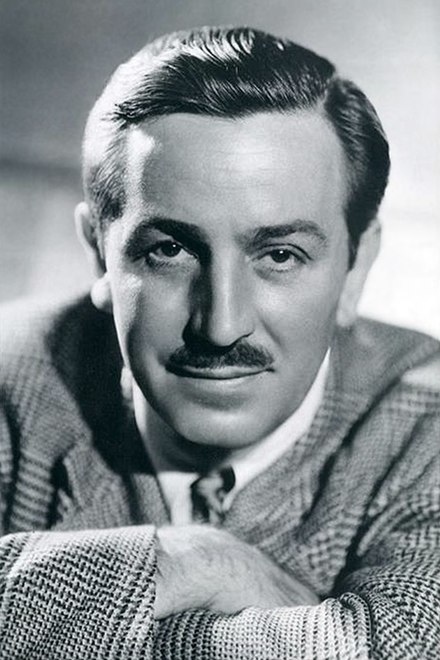
If there's anybody here who does not recognise this face, or at least knows the name Walt Disney, as my good friend Batty would say, fucking kill yourself. You don't deserve to live. Almost single-handedly (yes yes, Neapolitan: I'm getting to him, don't worry!) changing the face of animation forever, Walt Disney originally worked with his brother Roy as an animator for Winkler Pictures and later distributor Universal Studios, who could see the trend in cartoons developing with the popularity of Felix the Cat and other copies. The Disneys had tried selling some of their own animation but it had not been a successful or profitable enough venture, forcing them to work for the abovementioned. When disputes arose over pay, they left and formed The Disney Brothers Cartoon Studios, soon renamed to Walt Disney Studios.
Another of my fallacies exposed. Before I began this journal I firmly believed that the first ever animated cartoon was Steamboat Willie, but even that didn't come for another nine years after Felix and five after Disney's first proper animated feature, The Alice Comedies. Combining live-action and animation in a way that would go on to become something of a theme with Disney, and in a different way to that pioneered by Winsor McCay, the original pilot, as it were, was never released but did signal the beginning of the series in 1924, a series which ran for a staggering fifty-seven episodes, surely unprecedented way back then. Even now, that would be considered a good run, especially for something totally new. Alice (played by three different actresses during the series' run from 1924 to 1927, would have adventures with her cat Julius (who, as you can see, looks suspiciously similar to our Felix, though apparently this was intentional, presumably to “cash in” on the little cat's mass appeal), and no doubt the idea of mixing a live human actress with moving drawings certainly caught the attention.
Though Alice's Wonderland was never officially released, through the magic of YouTube you can sample it here. You can already see McCay's idea of using the medium of cartoons to allow fantastic things like bodies stretching to impossible lengths and contorting to impossible shapes, as the two cats on the table dance, and of course Sullivan continued and improved on this with Felix, allowing him almost limitless possibilities. The idea is stretched further here, as Julius, on the drawing board, tries to poke a real cat with his cartoon sword. The real cat, of course, sees and hears nothing and is unmoved, but it's very clever, especially when Julius scratches his head, wondering why his little sword is having no effect on the newcomer. The boxing match between the two cats also features what I believe to be the first use of that “cloud of fists and legs”, you know the sort of thing, when cartoon characters are fighting and it's just a whirling vortex out of which you can see heads, hands, feet?
Quite long at just over twelve minutes, as I say this gave birth to the long-running series which did not get going until a year later, and here are some examples of those.
The Alice Comedies ran until 1927, when Walt Disney responded to Universal Studios' eagerness to “get in on the cartoon game” and created the little guy below.
No, it's not an early sketch of that mouse, though I have to admit the similarities are quite stunning. This was the very first proper animated character created by Disney to have his own series, (as in, without any live-action actor or scenes) and he was called Oswald the Lucky Rabbit. Doesn't really look like a rabbit, you say? Take it up with Walt. Oh wait, you can't. So suck it.
Oswald (created as a rabbit due to a glut of cartoon cats in the wake of the success of Felix), like his famous descendant, survives to this day. Originally hitting the screens in 1927, just as The Alice Comedies came to an end, he went one step further than Felix or Julius, as Walt Disney wanted to create a character with his own distinct personality. I always felt Felix was a free-spirited individual who danced to his own drum, but people a whole lot more knowledgeable than me contend that Oswald was the first true anthropomorphic character who wasn't there just to “hang gags on”, so what do I know? At any rate, Oswald was not a hit right off, and had to be redesigned for his second outing, Trolley Troubles. As an aside, it's interesting how the idea of alliteration had pervaded even the earliest animation, with Felix's first short (as Master Tom) being titled Feline Follies and his next Musical Mews, a tradition that would go on to become a characteristic and mainstay of cartoons for decades to come. I wonder if it makes something more attractive, hearing two words that begin with the same letter? Or funnier? Or was there even a reason? At any rate, it became the standard for a long time.
Immediately the piece begins you can see that Disney is looking to Sullivan for inspiration, as it reads almost like a Felix cartoon, with elements of the fantastic and the absurd in abundance. Polishing the trolley with a cloth, Oswald then throws it behind him and it becomes his bobtail, the wheels of the trolley do that sort of running-in-place motion that would become the standard for characters as they prepared to run (attended by a round of bongo drums or some sort of percussion), almost as if they're winding up to let go, and a literally impossible number of passengers are taken on, given the trolley's tiny dimensions. But this is, or would be, cartoons, and you didn't have to explain anything. Everything was possible if you could think of it or imagine it, and no logic was required. Making people laugh, being clever and innovative was all that was needed to make a cartoon successful. As the trolley runs over wider and narrower tracks it becomes correspondingly wider or narrower to accommodate them, stretching and then scrunching inwards; a cow on the line which refuses to move is gone under by the trolley, which uses it as a kind of tunnel . For once in the film, logic and science are used; as the track climbs steeply upwards, Oswald finds he cannot control its ascent and the trolley begins to slide back down, and when he encounters a goat who butts him, Oswald uses this by harnessing the goat via a pole to him and goading him to butt him. Of course, once they reach the summit and plunge down the other side rollercoasterlike, the thing is out of control and flings passengers out left, right and centre as it careens along.
Into a series of tunnels the trolley hurtles (handy for the animator, as several frames are totally black as the train enters the darkness!) and Oswald pulls off his foot and kisses it (geddit? Lucky rabbit's foot?) as he prays to be delivered. In the end, the out of control trolley screams off the side of the mountain and into a lake, and Oswald punts away to safety on a raft. I assume all his erstwhile passengers have either been thrown clear prior to the train leaving the tracks or have drowned, but in what would become typical cartoon fashion, nobody asks the question: after all, they're just line drawings, aren't they?
Becoming unhappy with his lot at Universal Studios in 1928 Walt Disney decided to leave, allowing Universal to keep Oswald but designing a new character over whom he would retain control as he set up his own studios. But although he would create the first true animated film with synchronised sound, there is one other we have to look at before we trace the evolution of the character who would completely redefine and transform the world of animation.
__________________ Trollheart: Signature-free since April 2018
Last edited by Trollheart; 11-25-2020 at 03:13 PM.
Later famous for Betty Boop and Popeye, Max Fleischer had a different approach to animation compared to the likes of Walt Disney or even Winsor McCay, in that his technique tended to be less refined and more jerky, and his cartoons were not merely to entertain but often tackled adult issues and were on the whole darker and more mature than anything that was around at the time, or would be for some considerable time. His perhaps most famous early animation, preceding Disney's by two full years, was My Old Kentucky Home, released in 1926 and featuring a cartoon dog blowing a trumpet and encouraging the viewer to sing the words to the old nineteenth-century song. Although crude, even by the standards Disney would set down from the off (cruder even than Oswald or, in some ways, Felix) , this animation was important as it was the first to successfully synchronise audio to the animation, so that when the dog says”Follow the bouncing ball and join in everyone,” you can follow the shape of his mouth as the words are spoken.
Fleischer had pioneered the concept of “follow the bouncing ball” which would become a staple in animation, jumping in time with the music from word to word in a prehistoric version of karaoke. Of course, as an animation this one is boring (although I can only get an excerpt from it, and don't know if there was more than there is here, a mere fifty seconds) but it did establish an important precedent.
Paul Terry (who would go on to produce Terrytoons, one of the most less successful cartoon studios of the twentieth century, even though it did produce memorable characters such as Heckle and Jeckle, Mighty Mouse and Deputy Dawg) also brought an animation with sound to the screen a mere month before Disney stole the limelight with their cartoon. Terry's was called Dinner Time and featured what looks to be a crow (some sort of bird anyway) seeking his dinner. After unsuccessfully trying to catch a worm, he is then almost eaten by a cat as he stands on telephone wires and the cat leans out of the window of a building, trying to reel him in. Eventually the cat does catch him, but the bird flies off, taking the cat with him. The cat lets go, and clings on to the wires, but the bird returns and cuts them with his beak. As the cat falls we see ghostly images of each of his nine lives leaving him. He hits the ground, then climbs back up the nine lives, using them as stairs, to get back in the window from which he fell out.
Next we follow the adventures of a small dog, who stops at a lake and with a bone in his mouth sees his reflection holding a bone. In the improbable logic of the world of cartoons, the dog jumps into the lake, takes the reflection's bone and now has two! And so it goes on. You can see in the crude drawings the ancestors of later Popeye, and the paper used is curiously yellow, though that could be age. Still, none of the other, older cartoons looked faded. Anyway, the clip here will give you an idea, but I have to say, I don't see anything in the way of sound synchronisation, other than sound effects and the odd voice. Perhaps unsurprisingly, the cartoon did not endear itself to audiences, and a month later everything changed, forever.
__________________ Trollheart: Signature-free since April 2018
Last edited by Trollheart; 11-25-2020 at 03:14 PM.















 Hybrid Mode