Newbie requesting equipment setup recommendation - Music Banter Music Banter

Go Back   Music Banter > Artists Corner > Stereo & Production Equipment
Register Blogging Today's Posts
Welcome to Music Banter Forum! Make sure to register - it's free and very quick! You have to register before you can post and participate in our discussions with over 70,000 other registered members. After you create your free account, you will be able to customize many options, you will have the full access to over 1,100,000 posts.

Reply
 
Thread Tools Display Modes
Old 03-26-2023, 07:55 PM   #1 (permalink)
Registered Jimmy Rustler
 
Dr_Rez's Avatar
 
Join Date: Sep 2007
Location: USA
Posts: 5,370
Default

Quote:
Originally Posted by Guybrush View Post
Hi there

I think you should get something like a focusrite Clarett or Scarlett with enough inputs. I'd probably go for 8. The Roland Studio Capture is another good option, but it has aged a bit (I have one).

.
Second on the Focusrite. They have really good software, hardware, and the preamps are really clean imo. I used a Focusrite Scarlett 2i2 for years with much success.
__________________
*Best chance of losing virginity is in prison crew*
*Always Checks Credentials Crew*
*nba > nfl crew*
*Shave one of my legs to pretend its a girl in my bed crew*
Dr_Rez is offline   Reply With Quote
Old 03-26-2023, 08:18 PM   #2 (permalink)
Groupie
 
Join Date: Mar 2023
Location: Sacramento, C
Posts: 16
Default

Quote:
Originally Posted by Dr_Rez View Post
Second on the Focusrite. They have really good software, hardware, and the preamps are really clean imo. I used a Focusrite Scarlett 2i2 for years with much success.
Thanks for the recommendation, Dr Rez!!

One of the issues with audio interfaces is finding one with 3+ microphone inputs. I realize that I can use an XLR-to-1/4" adaptor to connect a mic to a Line In port, but I am not sure how important it is to preserve a balanced microphone signal. This is my ignorance showing....
Elderly_beginner is offline   Reply With Quote
Old 03-27-2023, 05:50 PM   #3 (permalink)
Juicious Maximus III
 
Guybrush's Avatar
 
Join Date: Nov 2008
Location: Scabb Island
Posts: 6,525
Default

Quote:
Originally Posted by Elderly_beginner View Post
Thanks for the recommendation, Dr Rez!!

One of the issues with audio interfaces is finding one with 3+ microphone inputs. I realize that I can use an XLR-to-1/4" adaptor to connect a mic to a Line In port, but I am not sure how important it is to preserve a balanced microphone signal. This is my ignorance showing....
If you do that, you won't hear the mic. Or at least not until you turn it way loud and get lots of noise in the signal. Certain audio like mic and instrument level sources need to be amplified before you can use them as line. So for a mic to get connected to a line-in, it should pass through a preamp first.

Mixers and audio interfaces have preamps in most of their channels (just not in their aux/line ins, midi ins, spdif etc). Some mics, like the Shure SM7B, might need a lot of preamping (upwards of 70db) and more than what a typical audio interface or mixer can give, so that might be another thing to be aware of (although condenser mics are generally good in this regard).

About the Yamaha MG10XU, I have one of those I believe, just slightly bigger. I like it a lot as it's cheap, sounds fine and has compressor on the channels to f.ex. keep vocals a little more level. I've actually never hooked mine up to a PC through USB and recorded with it that way because I prefer an audio interface, but it probably works fine.

By the way, note that condenser mics also need phantom power (power through XLR cable). Like for a mixer, just check how many channels have phantom power.
__________________
Something Completely Different

Last edited by Guybrush; 03-27-2023 at 05:59 PM.
Guybrush is offline   Reply With Quote
Old 03-27-2023, 07:47 PM   #4 (permalink)
Groupie
 
Join Date: Mar 2023
Location: Sacramento, C
Posts: 16
Default

Quote:
Originally Posted by Guybrush View Post
If you do that, you won't hear the mic. Or at least not until you turn it way loud and get lots of noise in the signal. Certain audio like mic and instrument level sources need to be amplified before you can use them as line. So for a mic to get connected to a line-in, it should pass through a preamp first.

Mixers and audio interfaces have preamps in most of their channels (just not in their aux/line ins, midi ins, spdif etc). Some mics, like the Shure SM7B, might need a lot of preamping (upwards of 70db) and more than what a typical audio interface or mixer can give, so that might be another thing to be aware of (although condenser mics are generally good in this regard).

About the Yamaha MG10XU, I have one of those I believe, just slightly bigger. I like it a lot as it's cheap, sounds fine and has compressor on the channels to f.ex. keep vocals a little more level. I've actually never hooked mine up to a PC through USB and recorded with it that way because I prefer an audio interface, but it probably works fine.

By the way, note that condenser mics also need phantom power (power through XLR cable). Like for a mixer, just check how many channels have phantom power.
I'm very intrigued by your first paragraph. I had not thought about the point that you make, although your explanation makes sense.

I have seen microphones for sale with built-in cable with 1/4" jack on the 'far' end. I wonder how that is used.....

The MG10XU has phantom power on all four XLR ports.

I am planning to use Shure PGA58 Dynamic Cardioid mics, although I'm not sure how to figure out if the MG10XU provides enough preamping. By preamping, do you mean Gain?

Looking at the MG10XU specs, I can't identify the spec that would address preamping of mics, although I admit that I'm a newbie wrt mixers and mics.

Maybe I'm in way over my head in terms of buying a mixer.....

Anyhow, thanks for the help!

Ralph
Elderly_beginner is offline   Reply With Quote
Old 03-28-2023, 08:12 AM   #5 (permalink)
Juicious Maximus III
 
Guybrush's Avatar
 
Join Date: Nov 2008
Location: Scabb Island
Posts: 6,525
Default

Quote:
Originally Posted by Elderly_beginner View Post
I'm very intrigued by your first paragraph. I had not thought about the point that you make, although your explanation makes sense.

I have seen microphones for sale with built-in cable with 1/4" jack on the 'far' end. I wonder how that is used.....

The MG10XU has phantom power on all four XLR ports.

I am planning to use Shure PGA58 Dynamic Cardioid mics, although I'm not sure how to figure out if the MG10XU provides enough preamping. By preamping, do you mean Gain?

Looking at the MG10XU specs, I can't identify the spec that would address preamping of mics, although I admit that I'm a newbie wrt mixers and mics.

Maybe I'm in way over my head in terms of buying a mixer.....

Anyhow, thanks for the help!

Ralph
By preamping, I do mean gain, yes.

I think the Yamaha mixer will suit you fine It's difficult to find exactly how many decibels of amplification/gain you can get, but I assume it may have to do with how you can also boost it with the EQ, maybe the compressor if it has makeup gain, etc. It should be fine.

On audio interfaces, it's usually specified in the specs. For example if you look up the full specs of the Focusrite Clarett+ 8Pre, you will find it says "Gain range: +57dB" on the mic channels. That means the preamp can amplify the signal up +57 db which would be just a little short of what you might want for a Shure SM7B.

The common way to tackle such a problem would be to get a standalone preamp, like the Focusrite ISA One, the Warm Audio WA12 or the Golden Age Pre-73 MKII pictured here:
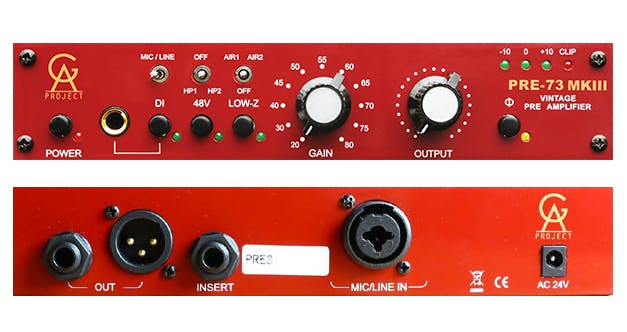


Here you can see it's a single channel preamp with an XLR input and output on the back and a gain knob that goes all the way up to an impressive +80db on the front. After preamping the SM7B with this, you could send it to a line-in / aux in on another unit like a mixer or audio interface. Thus, standalone preamps like this might let you get more mics into a unit, allowing you to also get mics into line ins.

But this shouldn't really be relevant for you because buying standalone preamps is expensive and probably not needed in your use-case I mention it mostly because I thought you might find it educational and interesting.

If you do find you need more mic channels, it's better to get a slightly larger mixer or audio interface.

I think you can imagine the following scenarios:

Recording a band live - you should have more than 4 channels because you might wanna stereo record acoustic guitars (2 channels per instrument), 1 mic for every singer/backup singer, maybe 2 mics for overhead (left/right) and if you have any drums, that's gonna be a lot. Recording bands live requires many channels.

The same band performing a live concert - Requires less channels than recording live because you can get by using instrument jacks for acoustic instruments (helps avoid feedback) and you wouldn't use overheads except maybe for drums. Drums and singers still require a lot of mics.

Recording by overdubbing - Depending on what you're doing, you might get by with as little as 3 mics or even 2, though I'd suggest 3. Something like a large condenser for recording vocals and a pair of pencil mics for stereo recording. This also lets you do setups like mid/side recording. A 4 channel audio interface would go a long way. Unless you have a drum set. Then you need lots more.

__________________
Something Completely Different

Last edited by Guybrush; 03-28-2023 at 08:18 AM.
Guybrush is offline   Reply With Quote
Old 03-28-2023, 03:03 PM   #6 (permalink)
Groupie
 
Join Date: Mar 2023
Location: Sacramento, C
Posts: 16
Default

Quote:
Originally Posted by Guybrush View Post
By preamping, I do mean gain, yes.

I think the Yamaha mixer will suit you fine It's difficult to find exactly how many decibels of amplification/gain you can get, but I assume it may have to do with how you can also boost it with the EQ, maybe the compressor if it has makeup gain, etc. It should be fine.

On audio interfaces, it's usually specified in the specs. For example if you look up the full specs of the Focusrite Clarett+ 8Pre, you will find it says "Gain range: +57dB" on the mic channels. That means the preamp can amplify the signal up +57 db which would be just a little short of what you might want for a Shure SM7B.

The common way to tackle such a problem would be to get a standalone preamp, like the Focusrite ISA One, the Warm Audio WA12 or the Golden Age Pre-73 MKII pictured here:


Here you can see it's a single channel preamp with an XLR input and output on the back and a gain knob that goes all the way up to an impressive +80db on the front. After preamping the SM7B with this, you could send it to a line-in / aux in on another unit like a mixer or audio interface. Thus, standalone preamps like this might let you get more mics into a unit, allowing you to also get mics into line ins.

But this shouldn't really be relevant for you because buying standalone preamps is expensive and probably not needed in your use-case I mention it mostly because I thought you might find it educational and interesting.

If you do find you need more mic channels, it's better to get a slightly larger mixer or audio interface.

I think you can imagine the following scenarios:

Recording a band live - you should have more than 4 channels because you might wanna stereo record acoustic guitars (2 channels per instrument), 1 mic for every singer/backup singer, maybe 2 mics for overhead (left/right) and if you have any drums, that's gonna be a lot. Recording bands live requires many channels.

The same band performing a live concert - Requires less channels than recording live because you can get by using instrument jacks for acoustic instruments (helps avoid feedback) and you wouldn't use overheads except maybe for drums. Drums and singers still require a lot of mics.

Recording by overdubbing - Depending on what you're doing, you might get by with as little as 3 mics or even 2, though I'd suggest 3. Something like a large condenser for recording vocals and a pair of pencil mics for stereo recording. This also lets you do setups like mid/side recording. A 4 channel audio interface would go a long way. Unless you have a drum set. Then you need lots more.
Wow, thanks so much for the extensive information!

My head is nearly full, LOL!
Elderly_beginner is offline   Reply With Quote
Old 03-28-2023, 03:23 PM   #7 (permalink)
Groupie
 
Join Date: Mar 2023
Location: Sacramento, C
Posts: 16
Default

Quote:
Originally Posted by Guybrush View Post
...
Guybrush, I hope you will indulge me with another question.

I was planning to buy Shure PGA58 mics because I had read that they are good for live vocals.

As a reminder, the plan is to gig at my home with 3-4 vocalists and 1-3 instruments (electric piano, electric-acoustic ukulele, and another guitar that is unknown, but probably acoustic-with-mix or electric).

Given that the Yamaha mixer might be marginal wrt providing enough gain for the Shure dynamic mics, would it be a safer choice to use condenser mics (maybe Audio-Technica AT2020) instead?
Elderly_beginner is offline   Reply With Quote
Old 03-28-2023, 03:56 PM   #8 (permalink)
Juicious Maximus III
 
Guybrush's Avatar
 
Join Date: Nov 2008
Location: Scabb Island
Posts: 6,525
Default

Quote:
Originally Posted by Elderly_beginner View Post
Given that the Yamaha mixer might be marginal wrt providing enough gain for the Shure dynamic mics, would it be a safer choice to use condenser mics (maybe Audio-Technica AT2020) instead?
For recording, I would generally prefer the AT2020s to the Shure dynamics. For performing, I would prefer the dynamics. The main advantage of the dynamic mics is you can hold them, drop them to the floor, less sensitive to other sources maybe so you get less bleed - it's good for performing.

The AT2020, you're gonna place that on a stand and probably have a pop filter. The singer will engage with it differently. It's not gonna be as versatile for performing, but it will probably sound better on a recording.

There's always exceptions - some voices just work well with a certain dynamic mic f.ex. But for recording, I use condensers. I'd consider ribbon mics too, but they seem too fragile and so I haven't dared

While I think you'd be just fine with the Shures in terms of gain, there's no question AT2020 will work well in this regard.
__________________
Something Completely Different
Guybrush is offline   Reply With Quote
Reply


Similar Threads


© 2003-2025 Advameg, Inc.